AI compute needs somewhere to live. Homes need energy that isn’t wasted.
Hestia Grid puts owned GPU clusters inside residential property — sell compute, collect rent, reuse what heat and solar the building can take. The pattern works beyond one country; we prove it first where the economics are strongest.
Two systems wasting energy in opposite directions
AI data centres are expanding faster than power grids and planning systems can keep up with — competing for land, water and grid capacity, and dumping the heat they generate straight into the atmosphere.
At the same time, homes across Europe spend a fortune heating themselves, mostly from gas or resistive electric heat, with no connection to the enormous surplus of usable heat being thrown away a few streets over.
A GPU cluster is a heat source that happens to also compute
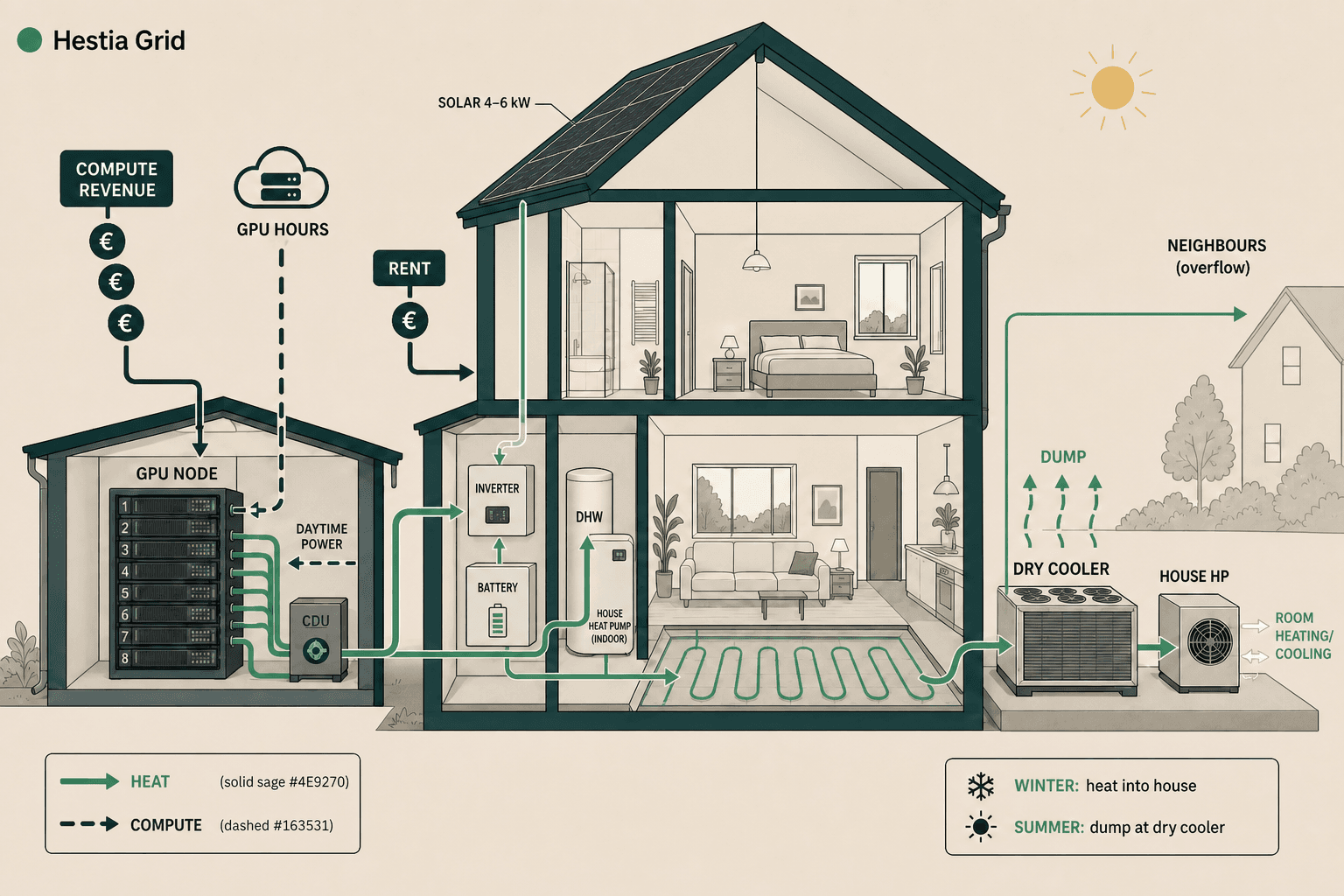
A rack of GPUs converts nearly all the electricity it draws into heat. Instead of building one huge facility and cooling it at cost, Hestia Grid places small, owned clusters directly inside houses — where the same electrical connection, the same site, and the same waste stream can support two income lines at once.
Own the property
The house itself earns market rent, appreciating like any residential asset.
Own the compute
The GPUs are owned outright and rented out directly as compute capacity, not leased through a middleman.
Reuse the heat
Waste heat from the cluster offsets the home's own heating bill — the efficiency link between the two revenue lines, not a third one.
This isn't a new physics problem
Data-centre waste heat is already being piped into swimming pools, district heating networks and greenhouses across the UK and Nordics — the same principle, at a larger scale.
Hestia Grid applies that same reuse logic at residential scale, and pairs it with direct compute ownership rather than a colocation lease.
Grid limits, AI demand, and EU sovereignty are all pointing the same way
Demand for AI compute keeps outpacing supply, while grid connection capacity for new large-scale data centres is becoming one of the hardest constraints to solve in the UK, France and Germany alike.
At the same time, EU buyers increasingly want compute that stays inside the EU, physically and legally — a requirement a distributed, owned network can meet more easily than a single hyperscale campus.
A small, real pilot — not a national rollout
We're validating this with a single property and one 8-GPU node in France before anything scales. Site selection is underway; we're targeting a late-2026 go-live and talking to potential compute customers first to size that pilot correctly.
Germany and the UK are on the roadmap — not live capacity yet. This is an early-stage concept currently being tested, not a live commercial offer.
Rough numbers for the first site — not a quote
These are working assumptions for our France pilot (one 8-GPU node, ~70% utilisation). We're validating them on the ground; final pricing and capacity are confirmed before go-live.
~4–5 kW facility draw
An 8-GPU node at pilot load draws roughly 3–4 kW of IT power (~4–5 kW including cooling overhead). Nearly all of it becomes recoverable heat.
~15–25% of winter heating
In heating season (Oct–Apr), captured waste heat could offset a meaningful share of a typical 100 m² home's heating bill — not all of it, and not in summer. Exact recovery is what the pilot measures.
€1.35–€2.40 / GPU-hour
Indicative sovereign-EU pricing band at pilot scale. Registered parties hear confirmed rates before any commitment. Volume and term affect the final figure.
Late 2026 target
One French property, one node, one go-live window. Expansion to Germany and the UK depends on pilot results and demand signals from this waitlist.
Built for a house, not a data hall
Pilot clusters sit in a dedicated, tenant-separated mechanical room: liquid-cooled racks, acoustic baffling, and dual internet paths (N+1 connectivity). Compute runs on dedicated circuits; waste heat ties into the existing hydronic heating loop via a closed-loop heat exchanger — no rack air dumped into living spaces.
France first — other countries help us prioritise
The pilot is being scoped with French planning, utility, and insurance requirements in mind. Running commercial compute in residential property raises zoning and landlord–tenant questions we're working through with counsel before we commit capital. If you select Germany or the UK on the waitlist, you're signalling future demand — only France will have live capacity at launch.
Want compute from the first site, or want to know more?
Join the founding waitlist — no cost, no obligation.
Go to the waitlist